Understanding How Target and The FAWCO Foundation Work Together

     Article Header Image 11


    Since its launch in 2009, the FAWCO Target Program has brought clubs across the FAWCO network together around a single project with the goal of creating greater collective impact.

    The first Target Project, Tabitha Wells for Clean Water in Cambodia, established the idea that clubs working together on one initiative could create meaningful and lasting change on a scale difficult to achieve individually. Since then, Target has remained one of FAWCO’s most visible collaborative initiatives, combining awareness, fundraising, and community engagement around issues affecting women and children worldwide.


    A Shared Effort with Distinct Roles

    Because Target is both a program and a large-scale fundraising effort, responsibilities are shared between FAWCO and The FAWCO Foundation.

    At a high level, FAWCO oversees the Target Program itself, while The FAWCO Foundation oversees the fundraising and financial administration that supports it.

    The FAWCO Foundation supports the fundraising and financial administration of Target, while FAWCO oversees the Target Program itself.

    This partnership allows both organizations to focus on their respective strengths while working together toward a shared goal.


    1031 NEWS 800 x 400 px 7


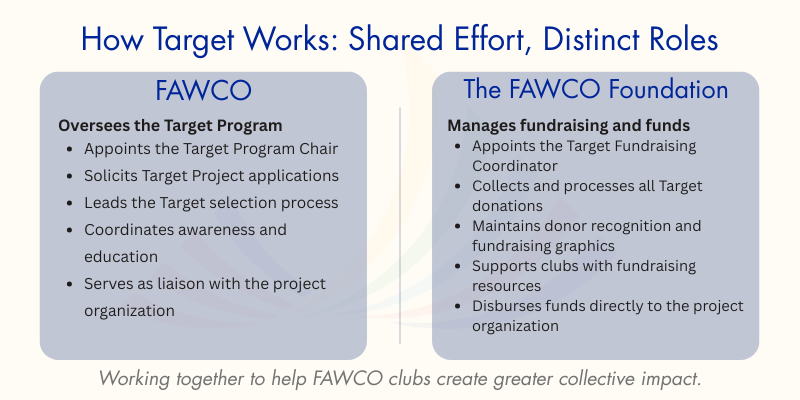
    FAWCO’s Role in Target

    FAWCO oversees the Target Program structure and leadership. This includes:

    • Appointing the Target Program Chair through FAWCO leadership
    • Soliciting and reviewing Target Project applications
    • Leading the Target selection process
    • Coordinating awareness and education around the Target issue
    • Serving as the primary liaison between FAWCO and the Target Project organization

    The Target Program Chair works under FAWCO leadership, specifically alongside the VP of Global Issues, and helps guide the overall direction and visibility of the Target initiative throughout the Target cycle.


    The FAWCO Foundation’s Role in Target

    The FAWCO Foundation oversees the fundraising and financial administration that supports the Target Project. This includes:

    • Appointing the Target Fundraising Coordinator
    • Collecting and processing all Target donations
    • Maintaining Target donor recognition materials and fundraising graphics
    • Supporting clubs with fundraising tools and resources
    • Disbursing Target funds directly to the Target Project organization

    While the Foundation supports the fundraising side of Target, it does not oversee the Target Program selection process or act as the liaison with the project itself.

    The Target Fundraising Coordinator works closely with the Target Program Chair throughout the Target cycle to ensure clubs have the resources and support they need to participate successfully.


    How Target Donations Work

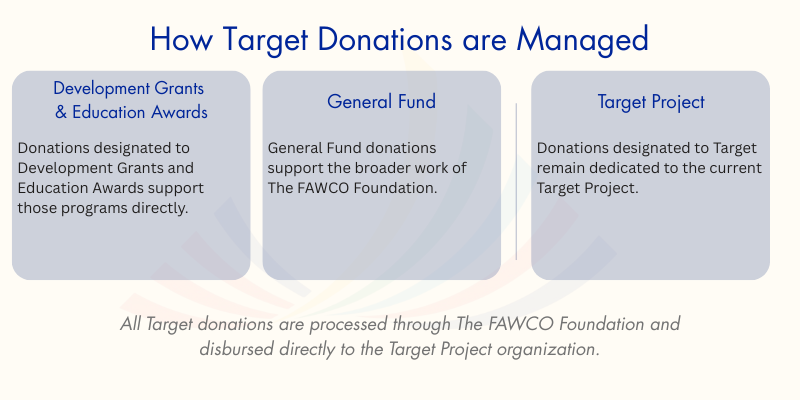
    One of the most important things to understand about Target fundraising is that donations designated to Target remain dedicated to Target.

    All Target donations are processed through The FAWCO Foundation and are maintained separately from other Foundation funds and programs.

    This means:

    • Donations to Target support only the current Target Project
    • Donations to Development Grants and Education Awards support those programs specifically
    • Donations to the General Fund support the broader work and operations of The FAWCO Foundation

    Target donations are not merged into the Foundation’s General Fund.

    This structure helps ensure financial transparency and allows donors and clubs to clearly understand how contributions are designated and distributed.


    1031 NEWS 800 x 400 px 8


    Why the Structure Matters

    The partnership between FAWCO and The FAWCO Foundation allows Target to function as both a community-driven initiative and a financially accountable fundraising effort.

    FAWCO leads the programmatic and educational side of Target, while The FAWCO Foundation provides the fundraising infrastructure and financial stewardship necessary to support the project responsibly and transparently.

    Together, this structure helps ensure:

    • continuity across Target cycles
    • accountability in financial administration
    • strong support for clubs and donors
    • clear oversight of both programming and fundraising

    Most importantly, it allows clubs across FAWCO to work together toward a shared goal while trusting that both the program and the funds supporting it are being carefully managed.


    Continuing a Tradition of Collective Impact

    At its heart, Target has always been about collective action.

    From the first Target Project in Cambodia to today, the program continues to reflect what can happen when FAWCO clubs around the world work together in support of a shared cause.

    The partnership between FAWCO and The FAWCO Foundation helps make that work possible — combining program leadership, fundraising support, and financial stewardship to help Target projects create meaningful impact around the world.


     Patti TFF Full color RGB 3


    The FAWCO Foundation’s Basic Fundraising Tool Kit

    Clubs are facing countless challenges to their bottom lines. They must try to keep expenses down while not raising membership dues to activity fees. Many feel that one solution for meeting these challenges is to enlist the support of outside organizations and businesses through sponsorships, advertising, or donations.

    Finding new contacts and establishing a relationship with them may require taking the “long view”; perhaps they will not be ready to sponsor your next event, but patience and perseverance could pay off down the road.

    The keys to building a partnership with your contacts are no different to building any relationship:

    • Learn something about the person and the company before your initial meeting.
    • Show an appreciation of their time and interest in your club.
    • Define the goals of your club and how you think their participation can help you achieve them.
    • Engage them and get their opinions.
    • Develop sponsorship programs that are creative and present the sponsor to its best advantage.
    • Do not promise anything you cannot deliver. Keep expectations at bay; it is better to overachieve than under achieve.
    • Don’t be greedy. It might take a bit more work on your part but getting 10 sponsors at $500 might be more attainable that getting one sponsor and $5000.
    • Be flexible. If you can come up with a plan together that suits both needs, you have the making of a great partnership!
    • There are never enough ways to say “thank you” to your sponsors.

    It is easier and more fun to do the project with two or three people. A team can ease the workload and inspire ideas. It also helps with moral support as less than 25% of marketing leads result in a sale* and your team must not take rejections as a personal loss!

    Where do you find these businesses and how do you make the connection that will turn into a mutually beneficial partnership? Finding these organizations starts with a bit of brainstorming and light detective work:

    • Look at your current business contact listing. Is it current? Spend an afternoon personally contacting each one and verify the contact’s name, address, phone numbers, updating website and email addresses. Do they have a Facebook page? If so, be sure to request them as a “friend”.
    • New contacts may be as close as your club directory. Most clubs probably have a sizable list of members who work. The information might be included in your directory, but if not, sorting the membership database can provide a list. If your club’s membership application doesn’t ask for this information, it should.
    • Some contacts may be right at home! Ask your partner (or the partners of other members) for the contact information of their company’s local marketing director and CSR director.
    • When attending an outside event, look at their sponsors and benefactors lists. Add them to your potential list of sponsors for your next event or activity.
    • Keep alert! When doing business in your local area, are there companies that you frequent that might be of interest to others in your club? Start a list of these companies and get their contact information.

    You have the lists, now what?

    • Turn your “outside” business contacts to “inside” business contacts. Are any of the people on your business contact lists eligible for membership in your club? If so, send them a membership application and invite them to a future club event. If they are not eligible, ask your board if it is possible to invite them to a club event. Be sure to spend quality time with them. Make a point to introduce them to your club president.
    • Make your club more accessible to members whose work doesn’t always allow them to come to club events. With your list of members who work, consider sending an email to each one inviting them to a club event. If the list is sizable, why not hold an evening or weekend event and personally invite each working member. Perhaps the theme of the event could be “The Wonders and the Wild Things about Working in (your city)”
    • Listen carefully to each of your invites. They will have opinions and ideas that can be of interest to your club. No matter what kind of event you have, be sure to give each of the invitees a copy of your recent newsletter or welcome brochure. Be sure to ask for their business card and provide yours as well as the club president’s card.
    • Send a note of thanking them for showing an interest in your club and coming to the event. Indicate that you would like to set up a time to get together soon to talk about their ideas and how they might help your club and how best to showcase their contributions to your members.

    The First Appointment

    The most important part of your meeting with prospective sponsors and donors is what you do before the meeting: preparation, preparation and preparation!

    • From your research on the company and your conversation with the contact, you should have some inclination as to what they are capable of doing for you. Set your goal according to what you think is possible to attain.
    • If the sponsorship is for an event that you have held in the past, bring information, photos and visual aids that will help the prospective sponsors understand where the money will go. Describe the success of the even in quantitative terms (For example, did it raise money for charity?). Also, be sure to indicate what improvements if any, are being made for the event and how that will enhance the opportunities for the sponsor.
    • As part of your preparation, create a simple to understand sponsorship program. It’s always a good idea to give a copy of the program to the prospective sponsor at the meeting. Whatever benefits or acknowledgements they will receive should be clearly stated. If they are to receive an acknowledgment in your newsletter, bring an example of the newsletter. If their logo is to be printed on a photo banner, show them a picture. Remember, don’t promise anything you can’t deliver!
    • Your prospective sponsor may not be able to make a commitment at your first meeting. Plan the appointment with enough lead-time so the prospective sponsor has time to review and get back to you. Try to set a specific time for you to get in touch with them.

    The Follow Up!

    As soon as possible, recap your notes from the meeting. Send a note to the prospective sponsor thanking them for the meeting. State what you discussed at the meeting. Answer any questions that were asked that you couldn’t answer at the time. Put a reminder in the note about when you will nick be contacting them.

    Hopefully, your prospective sponsor will have good news in the next call, if not, follow up with any concerns or questions that might arise. If you find it difficult to get a response, be patient. Don’t assume because they haven’t taken your calls that they aren’t interested! Let them tell you yes or no.

    If the Outcome is YES!

    Along with a thank you note, send a letter of agreement, which both parties should sign. Also, be sure to send them the information as to how the sponsorship money should be paid. The best way to assure continued success is for you to be the liaison throughout the process. After the event, let them know how successful the event was and be sure that everything that was agreed to by both parties has been completed.

    If the Outcome is NO...

    Send a note saying you understand the situation and perhaps another time. Be sure to update them from time to time. You have a better understanding of what they might be able to do for you in the future. If you have other prospective sponsor events, continue to invite them.

    A wise person once said, “You’ll never know unless you ask”. Good Luck!

    *2012 “B2B Benchmark Report” by Marketing Sherpa

    FAWCO Logo

    FAUSA new logo

    Keep Up With Us

    News Banner